
How a project actually runs
The method says what the phases and gates are. This page shows how a
project moves through them in practice: the tom_specs process that walks it step by step, the review
rounds inside the documents, the gates run against checklists, and the same process for a change to an
application that is already running.
The flow is not only written down; it is an executable process definition. A process engine knows the position of every project, queues the prompt of the next step for an agent, waits for your review and takes your decision at each gate. Tom UAM, the first project, has gone through Phases 1 and 2 this way and is in Phase 3.
Eight phases, eight gates - and change mode
The creation path runs from the free-form idea to production; every arrow carries a gate. A change to a running application is not a new project: it is a run of the same process in change mode, with a Phase 0 in front and a Phase 8C at the end.
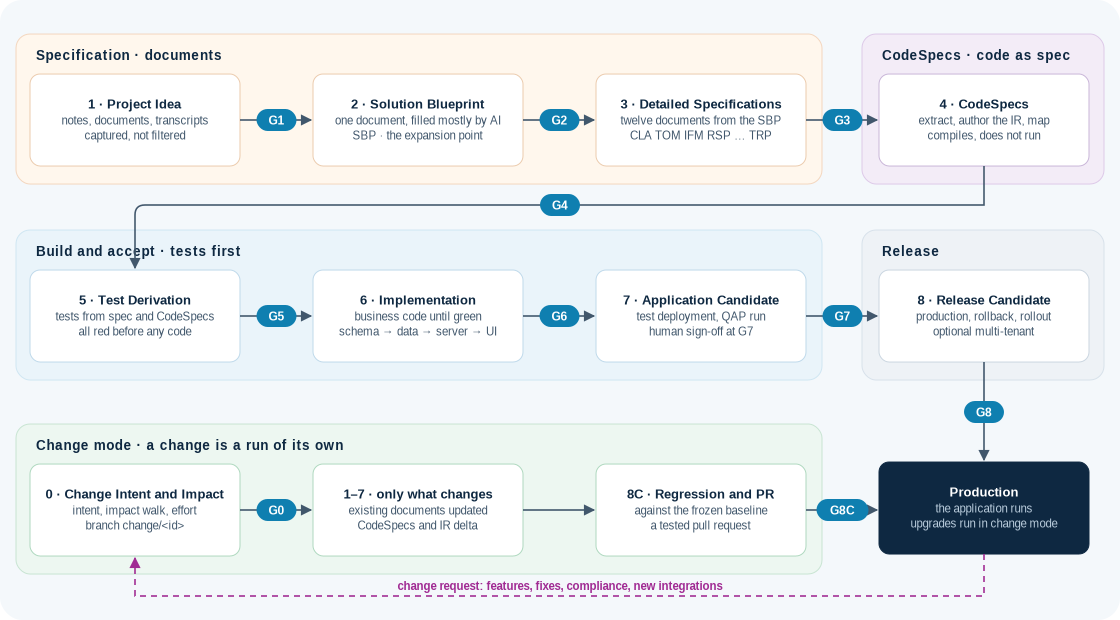
The tom_specs process
Phases 0 to 8 and 8C, each with its steps, sub-steps and a gate, stored in _ai/processes/tom_specs/. Every step has a role and a prompt; repeatable steps loop until their condition holds.
One position per run
A project can have several runs side by side - the initial development and a change, say - each with its own position, parameters, sessions and queue lane.
Steps that are yours
Reviews and gate decisions are user steps. The process stops there, shows the document, and moves on when you finish the round or decide.
The Blueprint is the expansion point
Phase 2 produces one document covering the whole system; Phase 3 expands defined regions of it into twelve. The mapping is part of the object model and is checked by its validator, so Phase 3 is a bounded, checkable task rather than "write twelve documents". A projection then routes every section to the code it feeds.
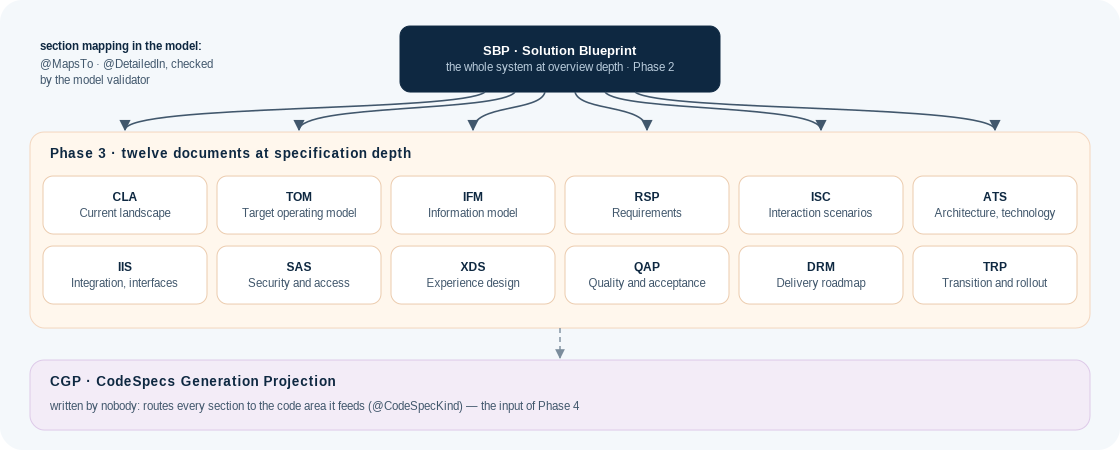
Inside Phases 2 and 3: a fixed step plan
Both specification phases run the same steps. Each step plans before it acts: it prepares its files, files its own todos and queues them as one walk, and ends by showing you the result.
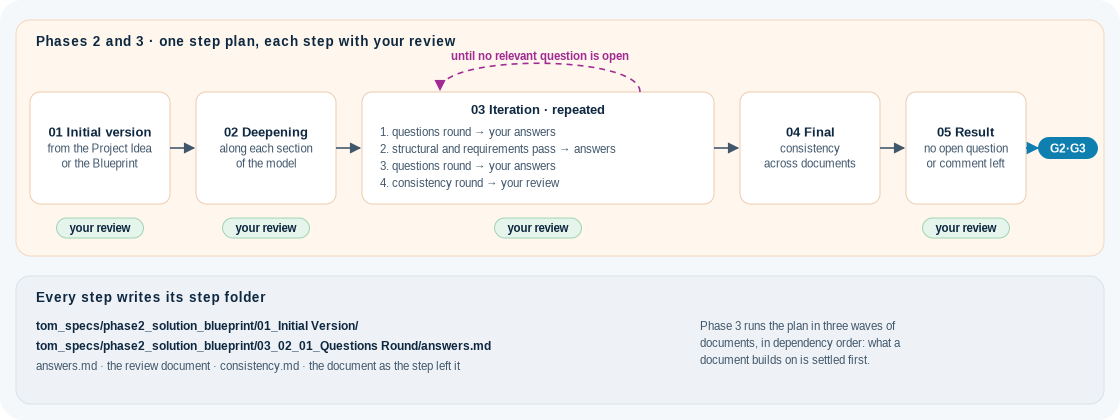
The iteration repeats until no relevant question is left open; Tom UAM's Blueprint took three iterations
(03_01_… to 03_03_…). Phase 3 runs the plan in three waves of documents in dependency
order, so a document is written only after what it builds on is settled. The step folders keep the document as
each step left it, together with that step's answers.md and review document, so every decision can be
traced to the round that made it.
Review rounds happen inside the documents
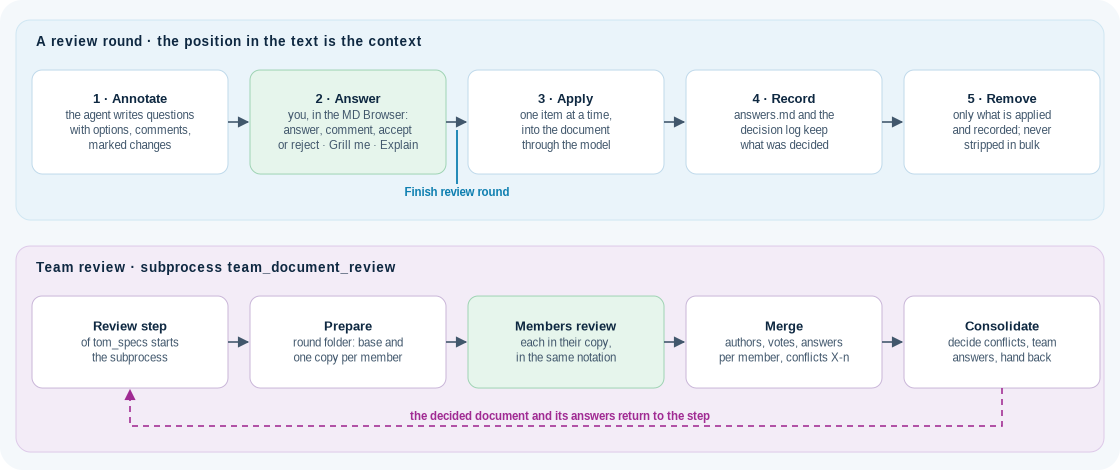
Questions, comments and proposed changes are written into the specification itself, where the text gives them their context. You answer in the MD Browser; the agent applies, records and only then removes.
The notation
A question block names its topic, offers lettered options with the recommended one in bold, states a working
assumption, and leaves room for the answer. Comments carry their author and change time. Inline changes use
CriticMarkup - {~~ 30 ~> 5 ~~}, {++ added ++}, {-- removed --} - and
are accepted or rejected one by one. All nine language runtimes read and write the same notation.
Team rounds
A review step can start the team_document_review subprocess: each member gets a copy, the copies
come back and are merged with authors, votes and individual answers, and where members changed a passage
differently a conflict block shows the alternatives for a decision.
Sessions expire after 30 minutes of inactivity.
> ⬆️ **C-12** (Alexis): Too long for shared kiosk devices.
> **❓ BQ-90 — C-12 kiosk timeout:** a shorter
> timeout for kiosk devices only, or for every device?
> - **(a)** kiosk devices only, 5 minutes
> - (b) every device, 15 minutes
>
> *Recommendation:* (a).
> *Working assumption until answered:* (a).
>
> **Answer:** (a)
Quality inside a phase
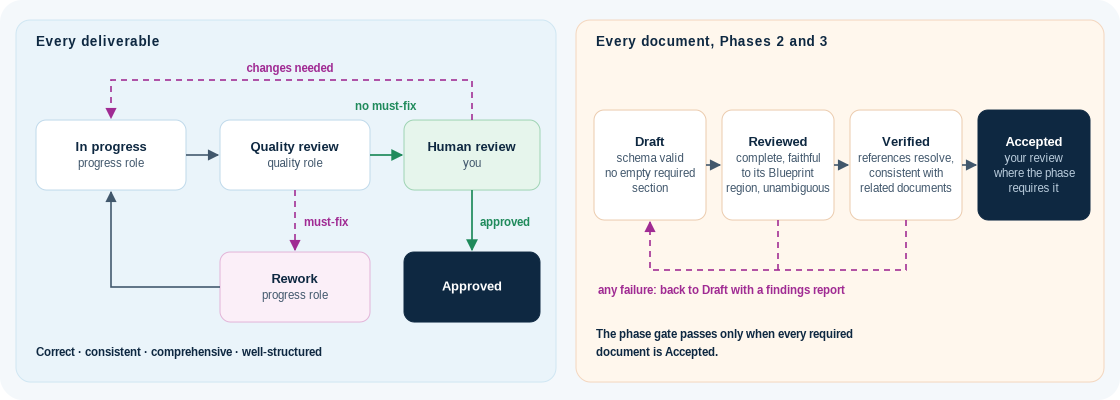
A gate checks a set of deliverables that should already be individually approved. Each deliverable loops between a progress role and an independent quality role; each specification document moves from Draft to Accepted.
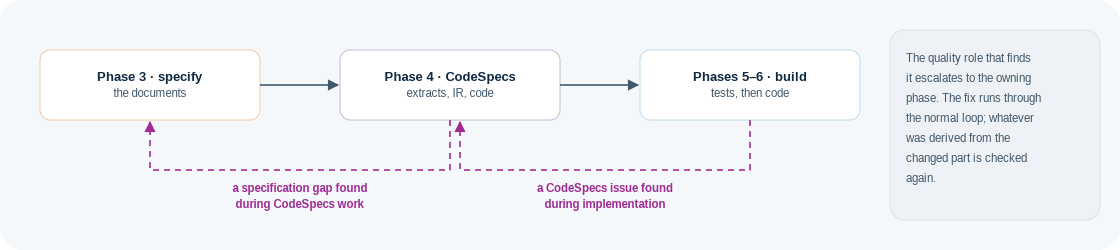
Producing a derived deliverable regularly reveals a gap in its basis. Then the process goes back to the phase that owns the defect instead of working around it.
Gates run against checklists
Every gate - G0 to G8 and G8C - has a generic checklist that a project copies and adapts. The gate step takes in what you answered since the last step, checks each criterion against evidence, writes a report with a recommendation, and shows it to you with the decision buttons.
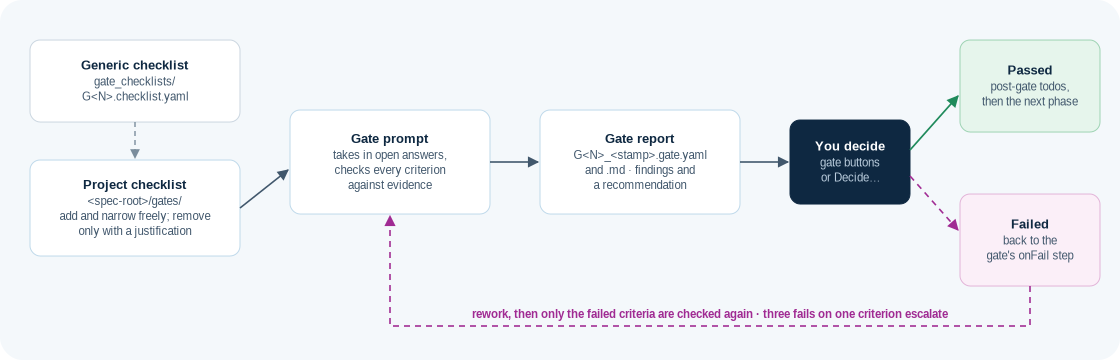
A project may add and narrow checklist items freely; removing one needs a recorded justification that the gate
report shows. Thresholds - coverage, performance, acceptable defects - come from the project's own quality plan
and architecture specification, not from the checklist. Reports are kept with the specification
(quality/evidence/gates/), so a gate result can be replayed against the criteria in force when it was
taken. The criteria of each gate are on the method page.
Phase 4: two passes with a fixed boundary
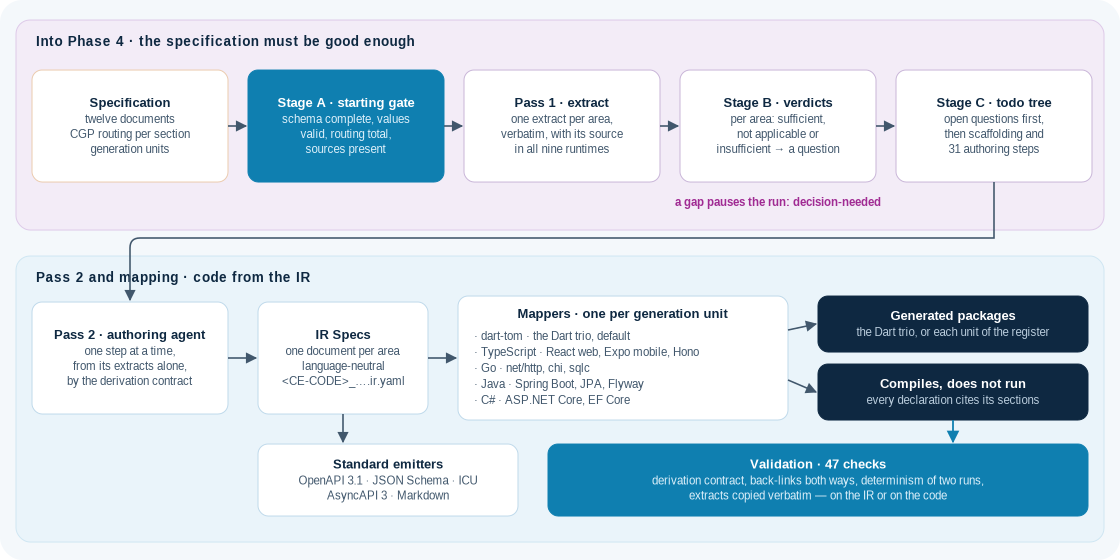
Phase 4 is neither a compiler pass nor free authoring. A gate at its start checks that the specification can carry code at all; the extract generator copies, the authoring agent judges, and each generation unit's mapper writes the code from the agent's IR.
A starting gate
Complete against the schema, valid on the instance tier, every section routed, every required argument backed by a filled source. A specification with holes produces code with inventions; this gate stops it first.
Extracts that only copy
One extract per code area - 27 of them - holding every routed field verbatim with its source. The generator may copy and index; it may never summarise, rephrase or choose a name.
Gaps become questions
Per area: sufficient, not applicable, or insufficient - naming the section that should have carried the missing input. Each gap is a decision-needed todo that pauses the run until the specification answers it.
The IR, then any stack
The agent writes the IR in 31 steps, each from its own extracts. The mappers write a Dart trio by default, or TypeScript, Go, Java or C# units; 47 checks validate the result.
Phases 5 to 8
The process defines their steps: a test plan and derivation by kind (acceptance, process, boundary, authorization, data, integration) with a red baseline; implementation in build order with code and security reviews; a test deployment run against the quality plan, documentation and sign-off; production configuration, migration and rollback, hardening, the optional multi-tenant setup and the rollout. They run on general agent work and the workspace's test and git tooling; no project has reached them yet, and they have no TomSpecs-specific tools so far.
Change mode
The first step of every run asks whether it is the initial development or a change. A change gets an id that
names its branch (change/<id>), its folder and its commits, and runs:
| Phase | In change mode |
|---|---|
| 0 | The intended effect and its exclusions; an impact walk over every section, code area, test and code unit with a verdict and the effort; the principles the change touches. You accept the impact at G0. |
| 1-3 | The existing documents are updated - only the impact set, wave by wave through the traceability of the model. Every review shows the last round's marks and a read-only copy against the commit the change started from. |
| 4 | The CodeSpecs and IR delta, computed by section token. |
| 5-6 | Against a frozen test baseline; tests the change makes false are marked expected to fail, then inverted. |
| 8C | The full regression against the baseline, and a tested pull request. G8C checks that nothing outside the impact set changed. |
Roles
Every agent step names its role, and the role's instructions travel with the prompt. A progress role and an independent quality role work each phase as separate agents - one agent checking its own work is not independent verification. The roles defined today:
| Role | Works on |
|---|---|
| spec_author | The Project Idea, the Blueprint and the Phase-3 documents |
| spec_quality_manager | Review and consistency of the specification, the gates of Phases 1 to 3 |
| codespecs_designer | Phase 4: the starting gate, extraction, the verdicts per area, the todo tree and the authoring |
| codespecs_quality_manager | The Phase-4 gates and validation |
| test_manager | Test plan, derivation and baselines of Phase 5, acceptance runs |
| senior_developer, code_reviewer | Implementation and its code review |
| security_specialist | Security review from Phase 3 on, and the security gate items |
| release_engineer | The test deployment of Phase 7 and the production release of Phase 8 |
| change_analyst | Phase 0: intent, impact walk and effort of a change |
The people stay where the decisions are: the business answers questions and accepts at G2, G3 and G7, engineers decide G4 to G6, operations G8.
Planned
- A status board per specification: every document with its open questions, rounds and gate results.
- A quality dashboard and trend reports from the evidence kept at the gates.
- TomSpecs tools for Phases 5 to 8, starting with the impact walk and expected-to-fail tests for changes.
The full process definition, with every gate's criteria, the issue workflow and the upgrade cycle, is the TomSpecs project flow.